


When bringing a complex hardware product to market, the transition from a design blueprint to a flawless production run is rarely a straight line. For hardware startups and enterprise R&D teams alike, engineering validation is the bridge that ensures a product is reliable, manufacturable, and scalable.
As a dedicated PCBA New Product Introduction (NPI) and engineering verification platform, 1943 provides a structured framework to identify design flaws, optimize manufacturing processes, and accelerate time-to-market.
What is PCBA Engineering Validation?
PCBA (Printed Circuit Board Assembly) engineering validation is a comprehensive testing and verification phase that occurs after initial prototyping but before high-volume manufacturing. It ensures that the electronic assembly meets all functional, environmental, regulatory, and yield-rate requirements.
Without rigorous validation, hidden design flaws or component incompatibilities can lead to high defect rates during mass production, resulting in costly re-spins and product delays.
5 Core Dimensions of PCBA Validation Services
To guarantee comprehensive hardware reliability, the 1943 platform breaks down the engineering validation process into five distinct, specialized phases:
1. Design Verification (DVT)
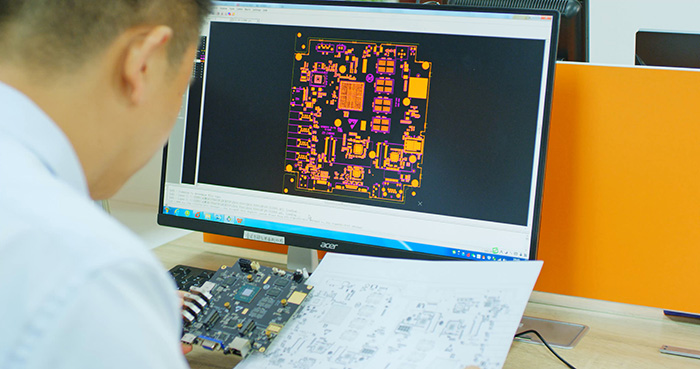
Design verification ensures that the hardware architecture matches the original specifications. This involves deep DFM (Design for Manufacturability) and DFT (Design for Test) reviews to catch layout errors, footprint mismatches, or signal integrity issues before the board goes to the assembly line.
2. Functional & Performance Verification
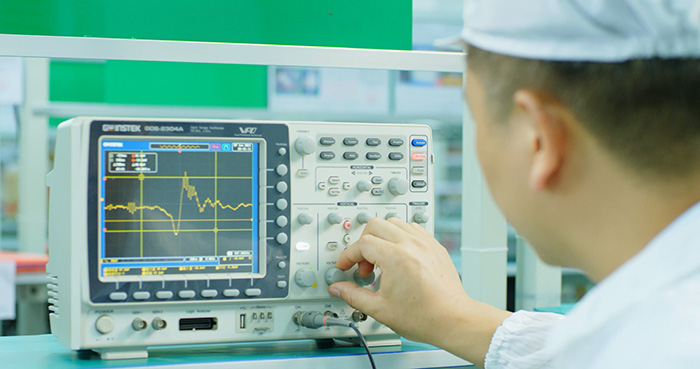
Does the board perform as expected under stress? We implement rigorous hardware testing, including voltage rail monitoring, signal debugging, and thermal profiling, to verify that the PCBA meets all electrical and operational benchmarks.
3. Process Verification
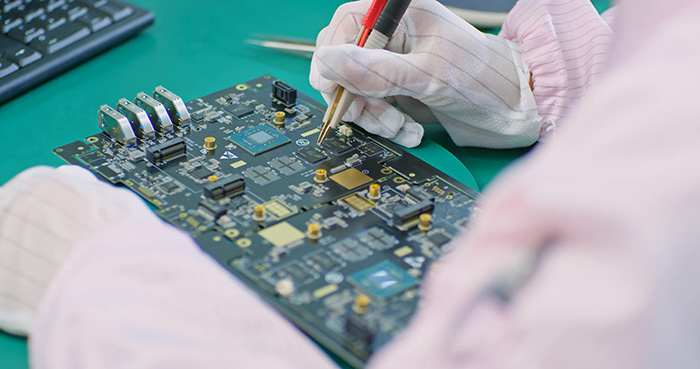
Process engineering focuses on optimizing the actual assembly line parameters. This includes analyzing solder paste deposition, reflow oven temperature profiles, and component placement accuracy to establish a stable, repeatable manufacturing baseline.
4. Compatibility & Adaptation Verification
Electronic components must work seamlessly within their mechanical enclosures and alongside other system modules. Adaptability verification ensures the PCBA fits perfectly within the final housing and interfaces correctly with peripheral connectors, antennas, and cables.
5. Production Verification (PVT)
The final step before mass production. PVT simulates a real production environment at a smaller scale to calculate stable yield rates, optimize cycle times, and finalize test jigs (FCT/ICT) for high-volume manufacturing.
The 1943 Advantage: Expert NPI Project Management
The core strength of the 1943 platform lies in our structured New Product Introduction (NPI) project management service.
Instead of treating validation as isolated testing steps, 1943 treats it as an integrated lifecycle. Our NPI framework provides:
-
Cross-Functional Coordination: Seamless alignment between layout designers, component procurement, and factory floor engineers.
-
Risk Mitigation Matrices: Early identification of single-source component risks and manufacturing bottlenecks.
-
Transparent Technical Documentation: Comprehensive validation reports that provide clear data for future product iterations.
Frequently Asked Questions (FAQ)
Q1: What is the primary difference between a standard PCBA prototype and an engineering validation run?
A standard prototype merely proves that a concept works under ideal conditions. An engineering validation run, however, evaluates whether the PCBA can be manufactured consistently at scale, with high yield rates, and under real-world environmental stresses.
Q2: Why is NPI project management critical for PCBA engineering validation?
NPI management ensures that engineering data transitions smoothly into manufacturing reality. Without strong NPI oversight, critical insights gained during the validation phase (like component adjustments or trace routing fixes) often fail to make it into the final mass production documentation.
Q3: How does Design for Manufacturability (DFM) impact production costs?
DFM analysis identifies potential assembly issues—such as component spacing errors, inadequate thermal relief, or incorrect pad sizes—while the product is still on paper. Fixing these issues early prevents expensive PCB re-spins and minimizes component wastage during production.
Q4: At what stage of hardware development should I engage with 1943's engineering validation platform?
The ideal time to engage is right after the initial schematic and layout design are completed, just before ordering the very first batch of engineering samples. Early engagement allows our NPI team to perform a proactive DFM review, saving time and costs on the first physical build.
 2026-05-29