

When bringing a high-performance electronic hardware product to market, selecting the right Printed Circuit Board Assembly (PCBA) manufacturing workflow determines both technical success and cost efficiency. For engineering and product teams, navigating the transition from a conceptual design to a physical, defect-free circuit board requires rigorous process controls, advanced Surface Mount Technology (SMT), and systematic project management.
This comprehensive guide breaks down the critical phases of the PCBA manufacturing process, highlighting how robust New Product Introduction (NPI) management prevents costly production bottlenecks.
1. The Critical Bridge: High-Performance NPI Project Management
The journey of a high-reliability PCBA begins long before the first solder paste is applied. The transition from design files (Gerber, Bill of Materials, and Centroid data) to the physical assembly line is highly complex. This is where dedicated New Product Introduction (NPI) project management becomes indispensable.
An effective NPI framework acts as an engineering filter, identifying potential manufacturing challenges prior to mass production.
- Design for Manufacturing (DFM) Review: Analyzing the PCB layout to ensure component spacing, pad geometries, and trace widths align with automated SMT placement capabilities.
- Design for Testing (DFT) Integration: Verifying that adequate test points are incorporated for In-Circuit Testing (ICT) and Functional Testing (FCT).
- Component Risk Assessment: Evaluating the Bill of Materials (BOM) for lifecycle status, lead times, and footprint compatibility to avoid unexpected production delays.
By treating NPI as a structured engineering discipline rather than a checkbox, companies can reduce engineering change orders (ECOs) and significantly shorten time-to-market.

2. Core Phases of the SMT Assembly Line
Surface Mount Technology is the backbone of modern electronics manufacturing, enabling high-density component placement with exceptional precision. A standard high-yield SMT assembly line consists of several synchronized thermal and mechanical operations:
Solder Paste Printing & SPI
The process begins with applying solder paste to the bare PCB pads through a precision laser-cut stencil. Immediately following printing, Solder Paste Inspection (SPI) machines utilize 3D optical measurements to verify the volume, alignment, and height of the deposited paste. Because statistical data shows that over 60% of assembly defects originate from improper solder printing, SPI is a critical quality gate.
High-Speed Component Placement
Once validated by SPI, the boards move to high-speed pick-and-place machines. Advanced vision systems inspect each component—from microscopic 01005 passives to complex, fine-pitch Ball Grid Arrays (BGAs)—before placing them onto the tacky solder paste with micron-level accuracy.
Precision Reflow Soldering
The populated boards enter a multi-zone reflow oven. The temperature profile is meticulously calibrated based on the board’s thermal mass, component sensitivity, and solder alloy specifications. The profile typically consists of preheating, soaking, reflow (where the solder liquefies and forms intermetallic bonds), and controlled cooling phases.
3. Advanced Quality Assurance and Inspection Frameworks
To guarantee structural and electrical integrity, a robust inspection ecosystem must be deployed throughout the SMT and through-hole assembly stages:
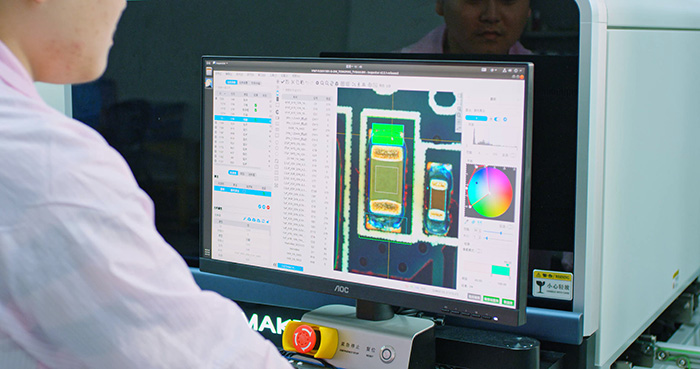
- Automated Optical Inspection (AOI): Positioned both pre-reflow and post-reflow, high-resolution AOI systems scan the boards to detect component misalignments, missing parts, polarity reversals, and solder bridging.
- X-Ray Inspection (AXI): For components with hidden solder joints, such as BGAs and Quad-Flat No-Leads (QFNs), X-ray imaging is utilized to inspect internal wetting, voiding percentages, and hidden short circuits without damaging the assembly.
4. Frequently Asked Questions (FAQ)
Q1: What is the primary difference between a standard PCB prototype run and a dedicated NPI service?
A standard prototype run focuses strictly on assembling a small batch of boards exactly as specified in the provided design files, without analyzing systemic manufacturing risks. In contrast, an NPI (New Product Introduction) service is a comprehensive engineering management process. It includes rigorous DFM analysis, component risk assessment, tooling optimization, and a detailed manufacturing readiness review to ensure the design can be scaled efficiently to high-volume production with minimal defects.
Q2: Why is 3D SPI (Solder Paste Inspection) critical for fine-pitch component assembly?
Fine-pitch components, such as BGAs and CSPs, have incredibly small solder pads with tight tolerances. Standard visual inspection cannot accurately measure the volume of solder paste deposited. 3D SPI measures the exact height and volume distribution of the paste, ensuring there is enough solder to prevent open joints, yet not too much to cause electrical shorts or bridging under the component body.
Q3: How does DFM (Design for Manufacturing) impact total PCBA production costs?
DFM analysis identifies design complexities that could cause assembly failures or require manual intervention. For instance, optimizing pad sizes reduces solder defects, and ensuring correct component spacing eliminates the need for expensive post-reflow manual rework. By addressing these issues during the NPI phase, you significantly increase production yields and lower overall manufacturing costs.
Q4: What documentation is required to ensure a smooth transition into SMT assembly?
To initiate an efficient SMT assembly process, an electronics manufacturer typically requires:
- Gerber Files / ODB++: Comprehensive layout data for stencil fabrication and PCB fabrication.
- Bill of Materials (BOM): A detailed list including manufacturer part numbers (MPNs), quantities, descriptions, and package types.
- Pick-and-Place Coordinates (Centroid File): X-Y data, rotation, and layer designation for each component to program the automated placement machinery.
 2026-05-22